
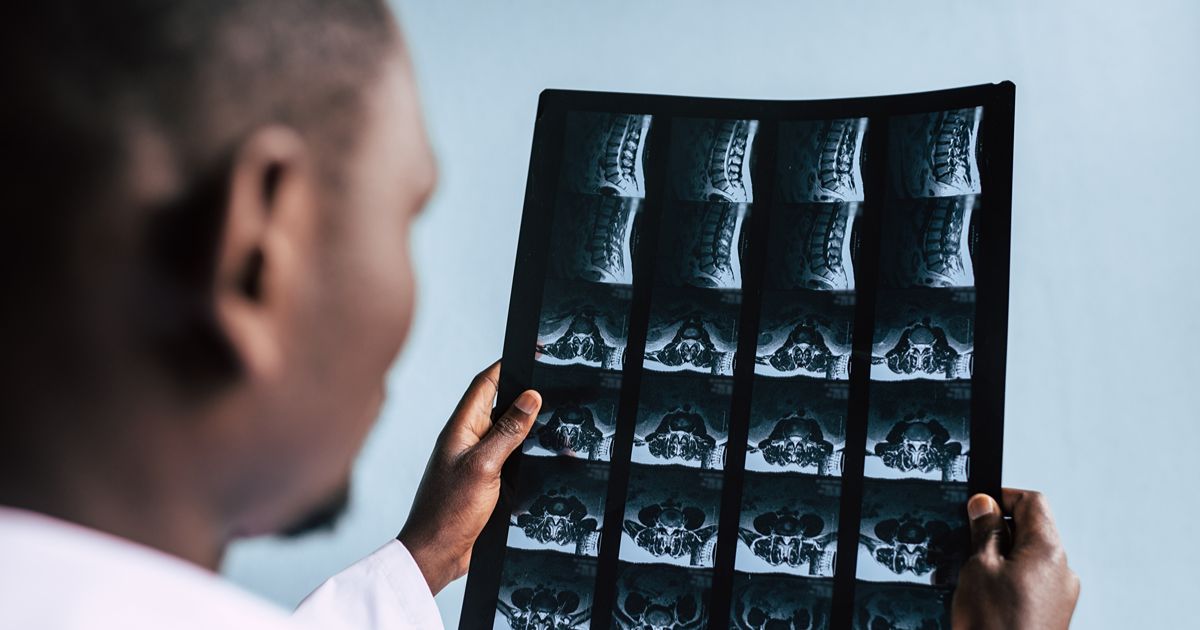
A spine MRI in Miami is really three separate exams: cervical for the neck, thoracic for the mid-back, and lumbar for the low back.
Your doctor chooses the section based on where your symptoms start, which isn’t always where they hurt most.
Each section gets its own time slot, its own set of images, and often its own insurance approval.
Which Part of the Spine Does Each MRI Cover?
The cervical spine is the 7 bones in your neck.
The thoracic spine is the 12 bones in your mid-back, where the ribs attach.
The lumbar spine is the 5 bones in your low back.
Cervical Spine MRI (Neck)
Doctors order this scan for neck pain. They also order it for pain, tingling, or weakness that runs into the shoulder, arm, or hand.
A pinched nerve in the neck often feels like an arm problem. That is why a patient with numb fingers may be sent for a neck scan.
Check the cervical spine prep page before your visit.
Thoracic Spine MRI (Mid Back)
This scan looks at the mid back. Doctors use it for pain that wraps around the rib cage, a suspected compression fracture, or signs of pressure on the spinal cord.
Read the thoracic spine prep steps before your appointment.
Lumbar Spine MRI (Low Back)
Doctors order it for sciatica, pain that shoots into the buttock or leg, foot numbness, or spinal canal narrowing.
The lumbar spine prep page covers what to wear and bring.
Why One Spine MRI Order May Not Cover Everything
Each spine section is its own exam. If your order says lumbar, the technologist scans only the lumbar spine. Adding the neck or mid-back takes a new order from your doctor.
Someone with both neck pain and low back pain may expect a “full spine” scan. The order only lists one section. The result is a second visit and, in many plans, a second prior approval.
Here is how to avoid that:
- Look at your order before the visit.
- Check that each named section matches where your symptoms are.
- Call your doctor’s office if something is missing.
If you need two sections, ask if they can be done back to back.
What Happens During a Spine MRI in Miami
You lie on your back on a padded table while the scanner takes pictures in sets. The machine makes loud tapping sounds, so you get earplugs or headphones.
According to RadiologyInfo.org, spine MRI exams can last anywhere from 15 minutes to an hour.
Before the scan, staff screens you for implants and devices. If you have a pacemaker, surgical hardware, or shrapnel, read about metal in your body and tell your doctor early.
Some scans use a contrast dye called gadolinium, given through an IV.
Doctors often add it after a past spine surgery, or when they need a closer look at infection or a growth. A standard scan for a disc problem usually does not need it.
The hardest part for most people is lying still while in pain. If your back pain makes that tough, ask your doctor about a pain-control plan for scan day.
Our centers stay open late and on Saturdays, and you can book many tests within 24 hours.
Book an MRI in Miami at a location near you.
What Your Spine MRI Results Can and Can’t Tell You
A spine MRI shows discs, nerves, the spinal cord, bone, and soft tissue in fine detail. It cannot tell on its own which finding is causing your pain.
That takes your doctor, your exam, and your symptoms together.
This matters because “abnormal” findings are common in people who feel fine.
A large review in the American Journal of Neuroradiology found that disc bulges appear in 30% of pain-free 20-year-olds and 84% of pain-free 80-year-olds.
A bulge on your report may be part of normal aging.
An MRI also has limits when it comes to nerves. It shows where a nerve is squeezed, but not how well the nerve works.
For that, your doctor may add a nerve conduction test. You can read more about how imaging helps detect nerve damage.
It is also not always the right first step. The American College of Radiology advises against imaging in the first six weeks of simple low back pain, unless warning signs are present.
When Back or Neck Pain Can’t Wait for a Scheduled MRI
Some symptoms need an emergency room, not an outpatient visit. Go to the ER or call 911 if you have:
- New weakness in one or both legs
- Loss of bladder or bowel control
- Numbness in the groin or inner thighs
- Back pain with fever after an infection or IV drug use
A radiologist reads your scan and sends a signed report to the doctor who ordered it. Talk through the results with that doctor before you make any treatment decision.
Getting the Right Spine Section Booked the First Time
Before you schedule, confirm your order names the right section: cervical, thoracic, lumbar, or more than one.
Open the matching prep page, bring your ID, insurance card, and any past spine images, and list every implant you have.
Then call 305-596-9992 to book a time that works for you.