
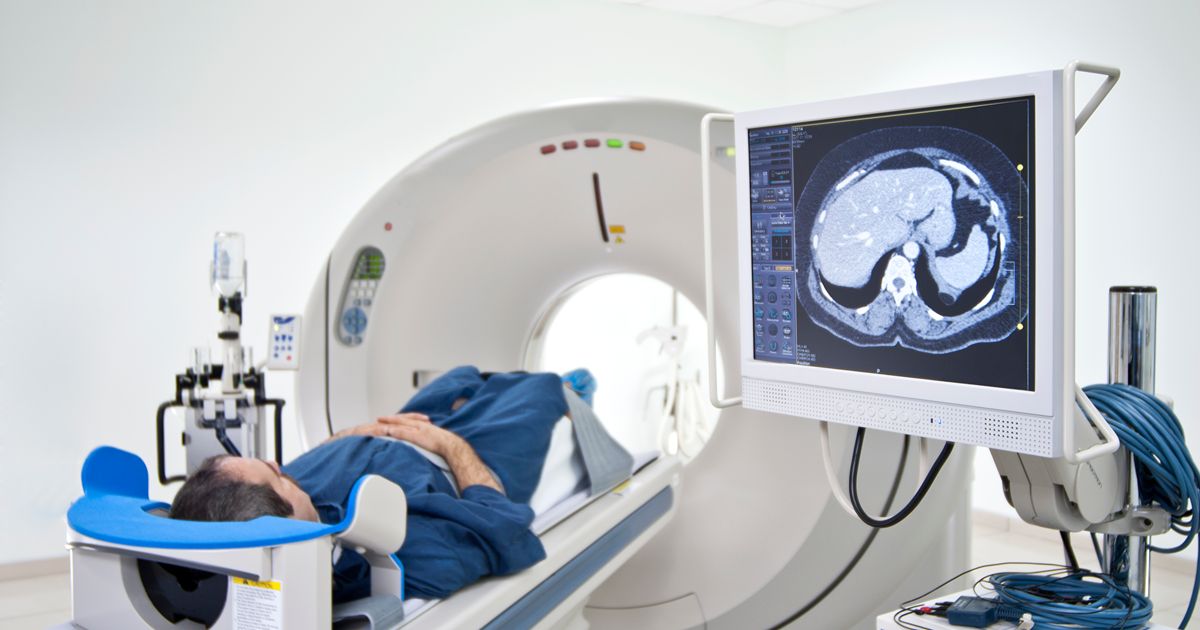
A CT scan for kidney stones is quick, painless, and usually done without contrast dye.
For most Miami patients with sudden side or back pain, it is the test doctors reach for first.
The scan does more than say “yes, there’s a stone.”
It measures the stone and shows exactly where it sits. Those two facts decide whether you wait it out or see a urologist.
Why Doctors Order a CT Scan for Kidney Stones
Doctors order a CT because it finds stones better than any other test. A low-dose CT without dye catches about 97% of stones, per the American College of Radiology.
By comparison, a plain X-ray finds about 59%, and ultrasound finds between 24% and 57%.
A CT also answers a second question. If there is no stone, it can show what else is causing the pain, such as appendicitis. That matters, because flank pain has more than one cause.
The tradeoff is radiation. ACR guidance points to low-dose scans under 3 mSv as the preferred approach.
If you want to compare that dose with other tests, our post on radiation from imaging puts the numbers side by side.
Our CT scan services page lists the scan types we offer.
What Happens During a Kidney Stone CT Scan in Miami
The scan itself is short, and most people need little or no prep. Follow any instructions your center gives you, since prep can differ by order.
Here is how a typical visit goes:
- Check in with your doctor’s order, a photo ID, your insurance card, and a list of your medicines.
- Remove belts, zippers, and anything metal around your belly and hips.
- Lie on your back on the table. The technologist slides it through a wide, open ring.
- Hold your breath for a few seconds when the technologist asks.
- You may be asked to roll onto your stomach for one more quick pass.
That last step surprises people. A stone can sit right where the ureter meets the bladder, or it can already be inside the bladder.
On a normal back-lying scan, the two can look the same. When you roll over, a loose stone in the bladder drops forward.
A stuck stone stays put. That one detail can change your whole plan, because a stone already in the bladder has done most of its trip.
Stone scans usually skip dye. Stones show up bright on their own, and the ACR notes that dye-enhanced CT finds fewer stones than a plain scan.
For what the rest of the day looks like, read about what happens after a CT scan.
What Your CT Report Says About the Stone
Size and location drive almost every decision after the scan. Smaller stones and stones lower down near the bladder pass more often.
European Association of Urology data give a useful picture:
- About 75% of stones smaller than 5 mm pass on their own.
- About 62% of stones 5 mm or larger still pass.
- Stones under 5 mm in the lowest part of the ureter pass about 89% of the time.
- Passage takes about 17 days on average, with a range of 6 to 29 days.
For stones 10 mm or smaller in the lower ureter, the AUA stone guideline says doctors should offer medicine to help the stone pass for about 30 days.
After that, it suggests repeat imaging to check whether the stone is gone.
Report words that worry patients
Hydronephrosis means the kidney is swollen because urine is backing up behind the stone. It explains the pain. Your doctor will weigh it against your symptoms.
Phlebolith is a tiny calcium spot inside a pelvic vein. It is common and harmless, but it can look like a stone. Radiologists tell them apart by the ring of swollen tissue that often surrounds a real stone.
When a CT Scan Is Not the Right First Test
A CT is not the best first step for everyone. Here are the situations where your doctor may choose differently:
- Pregnancy. The ACR calls ultrasound a first-line test here because it spares the baby from radiation. We offer ultrasound exams in these cases.
- Frequent stone formers. Repeated CTs add up. The ACR suggests reviewing past scans and using lower doses. Large known stones can sometimes be tracked with a digital X-ray.
- Certain HIV medicines. Stones made from drugs like indinavir can be invisible on CT, even when the kidney is blocked. Tell your doctor about every medicine you take.
- Fever, chills, or vomiting you can’t stop. A blocked kidney with infection is an emergency. Go to an ER right away.
Getting Your Stone Scan Booked Quickly
Pain makes waiting hard, so plan the paperwork early. Most plans need a doctor’s order for CT, and some need approval before the scan.
Call your plan or check your coverage before you book.
We offer appointments within 24 hours for many tests, plus evening and Saturday hours.
Our diagnostic center in Miami is one of several locations across Miami-Dade.
Your Next Move When Flank Pain Starts
If you have fever, chills, or can’t keep fluids down, go to the ER now.
If the pain is steady but you feel otherwise okay, call your doctor today and ask for a CT order.
Call 305-596-9992 to book your scan, and ask for a copy of the report so you know your stone’s size and location.
Leave a Reply