
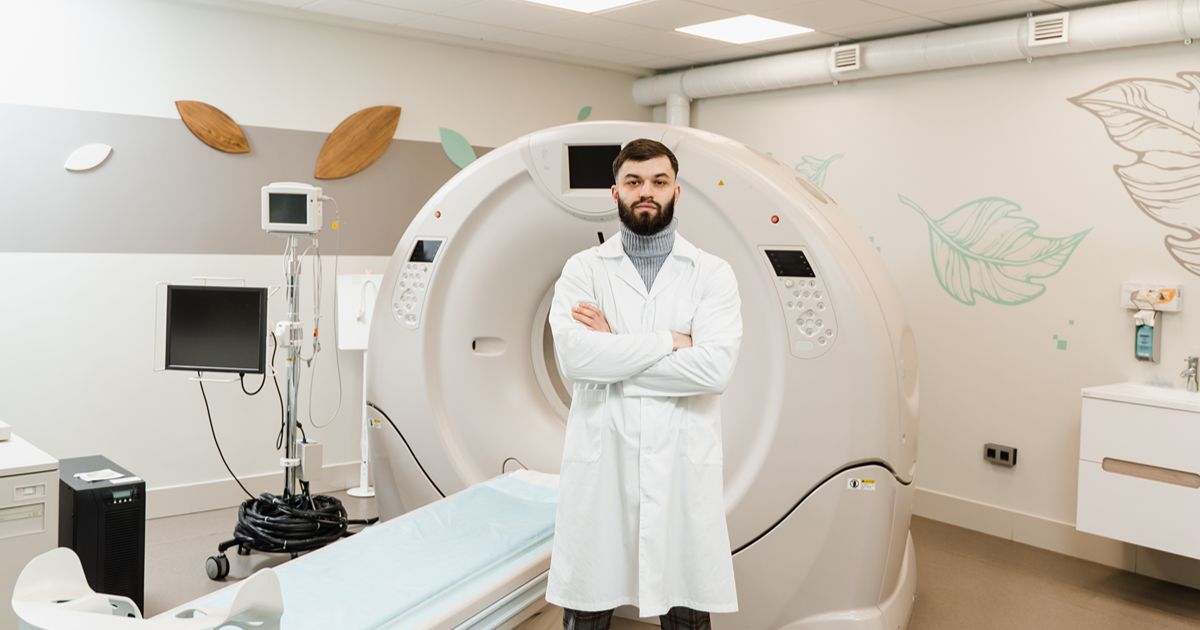
The best MRI center in Miami is the one with current accreditation, a scanner that fits the body part your doctor ordered, and a radiologist who reads that type of study every day.
Cost and wait time are very important, but they come second. Most people book the first place their doctor’s office sends the order to, and never ask a single question.
10 minutes on the phone can save you a repeat scan, a surprise bill, or a month of waiting.
What Sets One MRI Center in Miami Apart From Another
Two centers can charge the same price and hand your doctor very different information.
The difference comes down to three things: the scanner, the technologist running it, and the radiologist reading the images.
Miami-Dade has hundreds of outpatient imaging sites, and the quality range between them is wide.
Knowing the red flags to watch helps you spot a weak one fast.
Questions 1 to 3: The Building and the Machine
1. Is the center accredited, and by which organization?
Ask for the name of the accrediting body and the expiration date. Medicare requires non-hospital imaging providers to hold accreditation from an approved organization such as the American College of Radiology, the Intersocietal Accreditation Commission, or The Joint Commission before they can bill for MRI, CT, or PET. You can read the federal accreditation rule on the CMS website. A center that hesitates on this question is telling you something.
2. What is the magnet strength?
Most outpatient MRI scanners are either 1.5 Tesla or 3 Tesla. A 3T magnet is twice as strong as a 1.5T and picks up finer detail, which helps for brain, prostate, and small joint studies. A well-maintained 1.5T is still excellent for spine, knee, and abdominal work. What you want to avoid is a very low field magnet being sold to you as equal.
3. Is the scanner wide bore, and how long is my scan?
Wide bore scanners have an opening around 70 centimeters instead of the older 60 centimeters. That extra room makes a real difference if you are broad-shouldered, pregnant, or uneasy in tight spaces. Ask how many minutes you will be inside. These small details are what separate a reliable diagnostic center from one that treats you like a number.
Questions 4 and 5: The People Behind Your Images
4. Who reads my scan, and what is their specialty?
Ask if a board-certified radiologist with fellowship training in your body area will read the study. A musculoskeletal radiologist catches things on a shoulder MRI that a general reader can miss. Some centers send images to an outside reading service overnight. That is not automatically bad, but you deserve to know who is looking at your pictures.
5. Is the MRI technologist registered?
This one surprises people. Florida licenses X-ray, CT, and nuclear medicine staff, but the state does not certify MRI technologists. So the credential to ask about is ARRT registration in MR. A registered tech positions you correctly the first time, which means sharper images and a shorter scan.
Questions 6 to 8: Safety, Money, and Results
6. Will I need contrast, and how do you screen me?
Contrast is a gadolinium dye given through an IV, and only some studies call for it. A good center screens your kidney function and allergy history before injecting anything. They should also ask detailed questions about implants, since MRI uses a powerful magnet rather than radiation. The FDA explains the benefits and risks of MRI in plain terms, and our post on having metal in your body covers the screening in more depth.
7. What will I actually pay?
Ask for your estimated out-of-pocket cost in dollars, not a vague “we take your insurance.” Request the CPT code, then confirm the center is in network and find out if prior authorization is needed. Freestanding centers usually cost far less than hospital departments, which is one reason patients compare an imaging center versus a hospital before booking. Our breakdown of what insurance usually covers walks through the check step by step.
8. How fast will my doctor get the report?
Ask for several business days, not “soon.” Many outpatient centers turn routine reports around in one to two business days, and same-day reads are common for urgent cases. Also ask how you get your own copy of the images and report, since you may need them for a second opinion.
What Miami Patients Forget to Ask
Three practical things get overlooked here. Ask if staff can help you in Spanish or Haitian Creole, because clear instructions during a scan matter more than people expect, and bilingual MRI centers remove a lot of anxiety.
Ask if they can pull your prior scans for comparison, since a radiologist who sees last year’s images spots change faster.
And ask about parking and traffic timing, because a missed appointment slot can push you back two weeks.
The Ten Minute Call That Protects Your Diagnosis
Your MRI is only as good as the machine that makes it and the doctor who reads it.
Ask these eight questions before you book, write down the answers, and compare two or three centers.
If a scheduler cannot answer them or brushes you off, call somewhere else, because that same attitude will follow you into the scan room.