
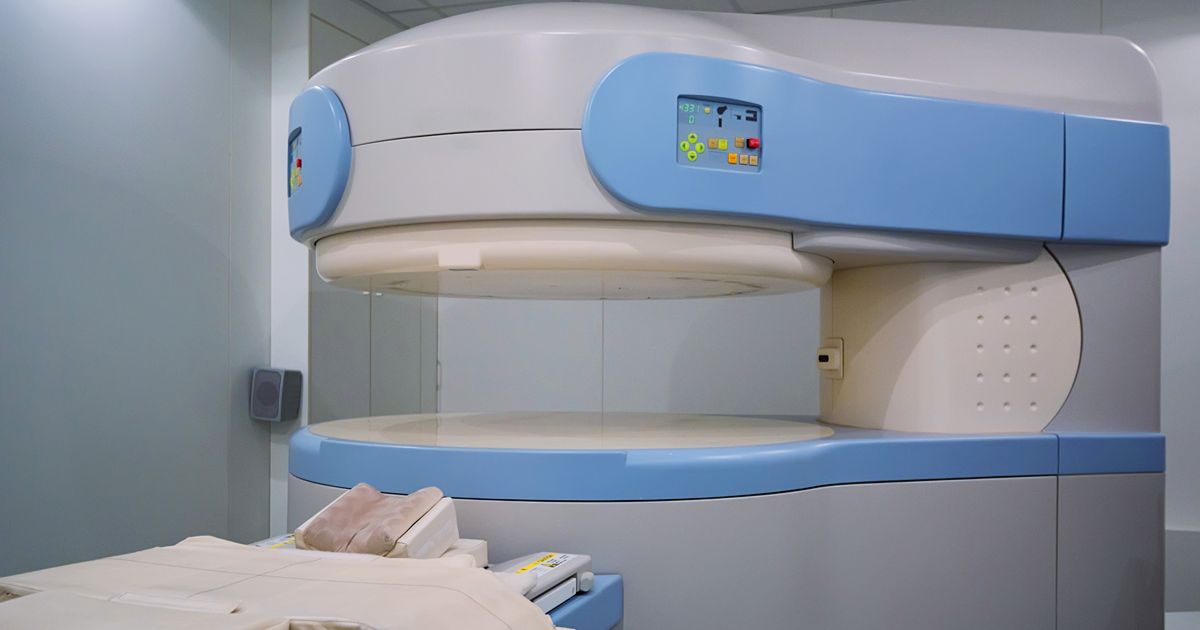
For most scans, a closed MRI is the better choice because its stronger magnet produces sharper images and your doctor gets a clearer answer.
The open vs. closed MRI question really matters when you cannot fit inside a standard machine or cannot stay calm in a tight space.
Those are real problems, and an open scanner solves them.
Before you pick a machine based on comfort alone, it helps to know what you trade away.
How Open and Closed MRI Machines Are Built Differently
A closed MRI is a tube. You slide into a cylinder that is open at both ends, and the magnet wraps all the way around you.
An open MRI looks more like a sandwich. Two flat magnets sit above and below you, and the sides stay open to the room.
Both use magnets and radio waves rather than radiation, which is one of the main benefits of MRI compared to CT and X-ray.
The FDA notes that MRI images are made without ionizing radiation, so neither design exposes you to it.
Image Quality Is Where Open vs. Closed MRI Really Splits
Magnet strength drives image quality, and the two designs are not close. Closed scanners typically run at 1.5 Tesla or 3 Tesla.
Most open scanners run between 0.2T and 1.2T, and many sit below 1.0T. A weaker magnet returns less signal, so the pictures show less fine detail.
That gap matters more for some studies than others. A lumbar spine or knee study on a good open machine can still answer your doctor’s question.
Small structures are harder. Brain lesions, pituitary studies, torn cartilage, and nerve detail all benefit from a stronger field, which is why an MRI for sports injuries is usually done on a closed scanner.
Lower field strength also stretches out your appointment. The machine needs more time to collect enough signal, so an open scan often runs longer than the same study on a 1.5T.
More time on the table means more chances to move, and motion blurs images.
When an Open MRI in Miami Is the Better Call
An open machine is the right answer in three situations:
- When your body will not fit comfortably in a standard bore.
- When anxiety is severe enough that you would otherwise need sedation.
- When a child needs imaging and staying still in a tube is unrealistic.
Size and fit
Bore width and table weight limits vary a lot by model, so ask for both numbers when you call. A patient who is broad through the shoulders may fit fine lengthwise but feel pinned in a 60 centimeter bore. Fit is not only about weight.
Anxiety and claustrophobia
Here is something most people do not expect. In a randomized trial of patients at high risk for claustrophobia, those scanned in an open machine were not significantly less likely to stop the exam than those in a short-bore closed machine. Open helps many people, but it is not a guarantee.
Simple steps like an eye mask, a mirror, music, and a squeeze ball often do more than the machine design does, and our tips for a calmer MRI visit cover them.
Children and pregnancy
Parents ask about this constantly. Open designs let a parent stand beside the table and keep a hand on their child, which cuts down on movement. If you want the safety details for children and pregnant women, we cover them separately.
Wide Bore: The Option Most Patients Never Hear About
Wide bore is a closed scanner with a larger opening, usually around 70 centimeters instead of 60. You still get 1.5T or 3T image quality, but with noticeably more room around your shoulders and face. For a lot of patients, this solves the comfort problem without the image quality cost.
I bring this up because many people call asking for an open MRI when what they actually need is a wide bore.
One study of claustrophobic patients found that once they were told a short bore machine gave better diagnostic performance, their preference for it rose sharply. Information changes the choice.
Four Steps to Pick the Right Machine Before You Book
- Ask your doctor which body part is being scanned and how much detail the report needs.
- Call the center and ask for the magnet strength in Tesla, not just “open” or “closed.”
- Ask for the bore width in centimeters and the table weight limit.
- Tell them about any implants, since some devices are cleared for 1.5T but not 3T. Our post on having metal implants explains the screening.
If you are still unsure after those four steps, the questions patients ask most often before a scan are a good place to keep reading.
Matching the Machine to the Answer You Need
The scanner is not the goal. A clear diagnosis is. Choose a closed or wide bore machine when image detail drives the decision, and choose open when fit or anxiety would otherwise keep you from finishing the scan at all.
A quick call to the imaging center, with your body part and your concerns in hand, settles it in about five minutes.